


 Contact us
 Visit CPRE.org
 Donate
Hedgerow Heroes Project: 2024-25

🎯Season target achieved! 2.4km of hedgerow created and restored
Building on the success of our first season (2023–24), we were thrilled to complete 2.4 kilometres of hedgerow planting and laying across Gloucestershire in this season.
We worked more closely than ever with schools, community groups, and individuals, giving them hands-on experience in hedge-laying and planting. It was inspiring to see participants embrace these skills, helping ensure the benefits of the project will be felt for years to come.
Alongside the practical work, we strengthened the Hedgerow Heroes legacy by supporting schools to incorporate countryside management into their curriculum. By championing these skills as part of environmental education, we helped inspire the next generation to care for and protect our countryside.
A huge thank you and congratulations to all our volunteers, landowners, partner organisations, our trainer, and our team for supporting us in reaching this vital our target for our countryside!
Season project sites
During this season, we worked across multiple sites in Gloucestershire. Explore the map to see our projects in action and why these sites are so important.
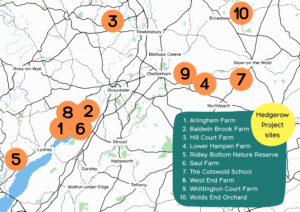
Site 1: Arlingham Farm
The site for the new hedge lies next to a hay meadow, once grazed by livestock and now dedicated to producing organic hay. The meadow is rich in wildflowers and native grasses, providing vital food and habitat for pollinators and other insects. Planting a hedgerow here will strengthen this habitat and boost biodiversity. The field is already bordered by an existing hedge that marks the land boundaries, and the new hedge will link with it — creating valuable connections across the landscape.
Site 2: Baldwin Brook Farm
Nestled within Lea Court Farm in the village of Framilode, near Gloucester, Baldwin’s Brook sits in beautiful countryside alongside the River Severn. Lea Court Farm is a working semi-organic farm producing high-quality beef with a strong focus on animal welfare and sustainable practices. As part of our project, a hedgerow will be planted in one of the livestock fields. This will not only provide shelter for the animals but also enhance local habitats. By linking the farmland to the River Severn, the hedgerow will create a vital corridor for wildlife, supporting birds such as lapwings, as well as red-listed species like the little owl and the pearl-bordered fritillary butterfly.
Site 3: Hill Court Farm
Longdon and Eldersfield Marshes were once Worcestershire’s largest wetlands, alive with otters, bitterns, swallowtail butterflies, and rich plant life. Drained for agriculture in the Victorian era, much of their natural splendour was lost. Naturalist Edwin Lee wrote in 1867 of autumn floods that drew vast flocks of geese, leaving the ground “white with feathers.”
Although the marshes lie mainly in Worcestershire, they extend into Gloucestershire too — which is why our charity is involved in their restoration. Work is underway to revive the grasslands and wetlands, creating wildlife-friendly farmland that supports lapwings, redshanks, skylarks, yellowhammers, and more. The hedgerow we manage, linking brook, woodland, fields, and wetland, provides a safe corridor for wildlife to move undisturbed.
Site 4: Lower Hampen Farm
The Handy family has farmed at Hampen for over 220 years, with the 7th generation caring for this Cotswolds National Landscape farm. The family’s approach places environmental stewardship and wildlife conservation at the heart of sustainable farming, with a focus on biodiversity and soil health for future generations. Their flock of rare pedigree Devon Closewool sheep provides both meat and fine wool.
Working with nature is central. By minimising soil disturbance and avoiding artificial inputs, they nurture healthy soils. Their arable rotations include species-rich herb leys, winter cover crops, and legumes grazed by livestock to enrich the land. Multi-cropped fields and florally enhanced margins support pollinators and beneficial insects, while heritage grains are grown for local bread flour and malting barley.
The farm’s hedgerows also play a vital role. One, rich with hazel, alder, and hawthorn, runs between arable and grazing fields and is part of a project to boost biodiversity in less diverse areas of the farm. The local secondary school is also involved, giving students the chance to connect with nature and explore future careers in farming and conservation.
Site 5: Ridley Bottom Nature Reserve
A fragment of ancient woodland greets visitors at the entrance to Ridley Bottom, home to small-leaved lime, ash, pedunculated oak, and silver birch. Old lime hedgerows, believed to be hundreds of years old, enclose three small meadows rich with grassland flowers, including common spotted, heath spotted, and lesser butterfly orchids. Cowslips, field scabious, and yellow-wort can be found alongside woodland wildflowers like wood anemone, sanicle, and primrose, suggesting a woodland heritage. Birds such as blackcap, linnet, tree pipit, and coal tit are drawn to the reserve’s tranquillity. The hedgerows provide safe passage for small mammals moving between nearby woods and meadows. Footpaths link Ridley Bottom to neighbouring reserves, Poors Allotment and The Park, which is a heathland restoration area. Hay is harvested from the meadows in July, with sheep grazing from mid-July to December. The hedge plants provided by CPRE will help fill gaps in the existing hedge and connect it to a new one, providing valuable space for wildlife.
Site 6: Saul Farm
This mixed-use farm specialises in the organic production of chicken eggs and also has a small flock of sheep, farmed according to organic regulations. Lucy and Gemma (mother and daughter) work together with a strong vision to transition towards regenerative farming. The site is large, encompassing a range of habitats, including wetlands, woodlands, riparian zones, farmland, and grasslands. The new hedge will be planted in an organic field used for grazing sheep. It will provide shelter and help connect the various habitats across the farm, creating a more cohesive and biodiverse environment while enhancing the existing habitats.
Site 7: The Cotswold School
The Cotswold School is an 11 to 18 academy in Bourton-on-the-Water, Gloucestershire. The school’s playing fields include part of the Cotswold Way, a popular hiking route. The new hedge will be planted to visually separate the wildflower/hay meadow from the playing field. On planting days, students will learn about the importance of hedgerows in our landscape and have the opportunity to gain skills in the countryside sector.
Site 6: West End Farm
Set in a perry pear orchard on an organic cattle farm, West End Farm offers almost poetic views from its spectacular location in the horseshoe bend of the River Severn, on the edge of the peaceful Gloucestershire village of Arlingham. Adjacent to the river, with easy access to the Severn Way footpaths, this working arable farm has been in the same family for multiple generations. It boasts a variety of habitats, including orchards, meadows (both grazed and ungrazed), and arable fields. In 2024, a community-run café was established on the site to foster community cohesion and provide a warm space for residents during the colder months. The new hedgerow will connect the orchard and the river, strengthening and enhancing the farm’s diverse habitats.
